Columbus Industrial Looks Sold Out. Its Empty Buildings Have a Loan Problem.
Every Columbus industrial report this summer told the same story. The market has tightened, big-box vacancy has collapsed, and tenants who waited for a better deal waited too long. Colliers put Columbus vacancy at 5.00% in the second quarter and reported that roughly 92% of the industrial space delivered since 2022 is now occupied or under lease. If you need 300,000 square feet in Etna or Rickenbacker next year, the headline says you are negotiating from weakness.
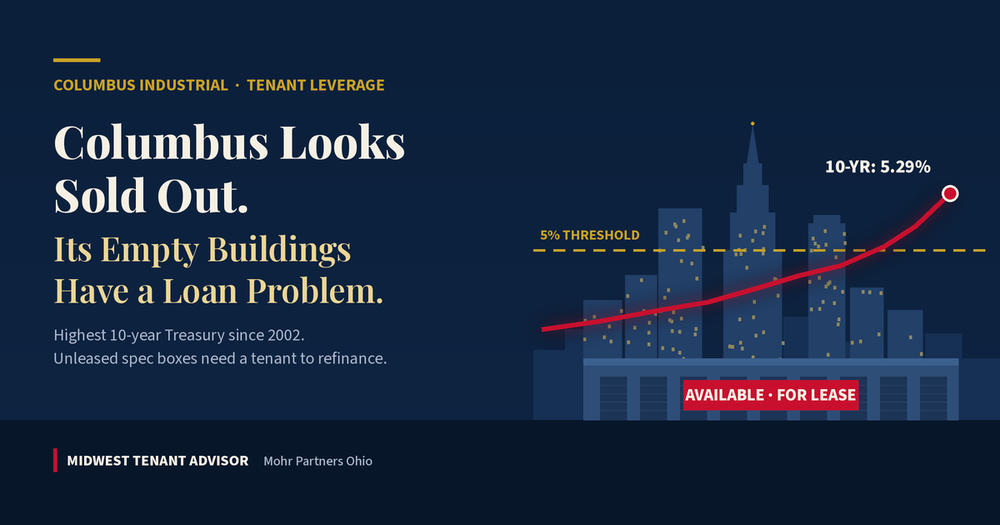
The headline is reading the wrong number. On September 30 the 10-year Treasury closed near 5.29%, its highest level since 2002. That capped the largest quarterly rise in the benchmark since 1994. The move did nothing to Columbus vacancy. It did a great deal to the new buildings that are still empty, and to the landlords who borrowed to build them.
The Columbus industrial market is tight. The capital stack is not.
The vacancy figure depends on whose report you read: Colliers says 5.0%, Matthews 6.4%, Savills 6.6%. The direction is not in dispute. Absorption has run hot for a year, and the large-format segment has tightened fastest.
Inside that tight market sits a specific class of building: the speculative bulk box delivered in the last 18 months without a tenant. Colliers counted three of them in Q2 alone, totaling 926,440 square feet delivered with no pre-leasing. CoStar showed roughly 13.3 million square feet under construction as of Q1, almost all of it speculative. And Colliers' own data says new Columbus product takes an average of 16.4 months to stabilize.
Sixteen months is the number that matters to your negotiation. It is longer than many of the loans behind those buildings can comfortably wait.
How a construction loan becomes tenant leverage
A spec developer builds with a floating-rate construction loan. The loan is sized on cost, priced off short-term rates, and typically due within about three years. The plan has three steps: deliver, lease, and refinance into permanent debt. The third step is where 2026 broke the model.
Permanent lenders size loans on income, and an empty building has none. Even a leased one now struggles with the math. Ten-year CMBS quotes run roughly 7.25% to 8.75%, while Columbus industrial trades near a 7.1% cap rate. When borrowing costs more than the building yields, lenders refinance only on proof of durable income. That means a signed lease with a creditworthy tenant.
Consider an illustrative example; it is not a specific property. A 500,000-square-foot spec building costs $50 million all-in and carries a $32.5 million construction loan at about 7.75%. Interest alone runs roughly $210,000 a month before taxes and insurance. Leased at $6.50 net, the building produces $3.25 million of income. At a 7.1% cap rate it is worth about $45.8 million, below its cost. A permanent loan at 7.5% with standard coverage supports about $31 million, which is short of the balance it has to repay.
Now look at the negotiation from the landlord's side of the table. Six months of free rent on that building costs about $1.6 million. Eight more months of vacancy costs about the same in interest, plus the risk of hitting maturity empty and refinancing into 10%-plus bridge debt or writing an equity check. Your concession request is not a cost to that landlord. It is the cheaper option.
Why this reaches beyond a few empty buildings
The Mortgage Bankers Association estimates that 23% of outstanding industrial loans mature in 2026, a larger share than office. Many were written between 2015 and 2022, when borrowing costs sat near historic lows. For a stabilized second-generation building, your renewal is part of the landlord's refinancing package. A lender underwriting a building with a major lease expiring 18 months out will haircut the loan or demand reserves. A tenant who renews early removes that problem, and that is worth paying for in rent.
Sublease space is a second pocket. KBC Advisors tracked roughly 1.6 million square feet of Columbus sublease availability at the end of Q1, and noted it has not moved with the same urgency as direct space.
We have seen this pattern before. Indianapolis industrial looked equally tight this summer, and Louisville's leverage was hiding in the same place: the debt, not the vacancy rate.
Threats & Opportunities
Threat: the window closes from both ends. The remaining spec boxes will lease, and once they do, the motivated landlords are gone. Meanwhile 5%-plus Treasuries will choke new construction starts. That means thinner supply in 2027 and 2028, which is exactly when many of today's deferred renewals come due.
Threat: a stressed landlord can become your problem. An owner who cannot refinance may be unable to fund a tenant improvement allowance or roof replacement. Vet the owner's capacity before you sign, and negotiate escrowed improvement dollars or rent-offset rights.
Opportunity: target the empty spec building. Its owner has a dated reason to deal. Construction-loan timing is often traceable through public mortgage records. A term commitment from your company is what turns that building into a financeable asset, so price it like one.
Opportunity: renew ahead of your landlord's maturity, not yours. As we argued in Your Landlord's Mortgage Is Your Best Leverage in 2026, the calendar that matters is the loan's. An early renewal 12 to 24 months before refinancing is worth more to the owner than at any other point in the lease.
Scott Pollock is Managing Partner at Mohr Partners Ohio, which represents tenants exclusively, never landlords. If your Columbus-area industrial lease expires in the next 24 months, or you are evaluating a new spec building, we will pull the debt behind the property and tell you how much leverage its loan is handing you. Reach Scott at scott.pollock@mohrpartners.com or 440.821.8149.