From Fixed Headcount to Flexible Capacity: A Midwest Tenant's Take on Transaction Management
Last month, Mohr Partners Chairman and CEO Bob Shibuya published a white paper titled From Fixed Headcount to Flexible Capacity, and it has drawn a lot of attention from corporate real estate leaders. Its subject is transaction management outsourcing: specifically, why the industry is moving away from dedicated, fixed-fee teams toward capacity that scales with actual deal volume. It's written for large corporate portfolios, but I think the argument matters just as much for mid-market Midwest occupiers. Here is what the paper says, and where I'd take it further.
What the Paper Argues About Transaction Management Outsourcing
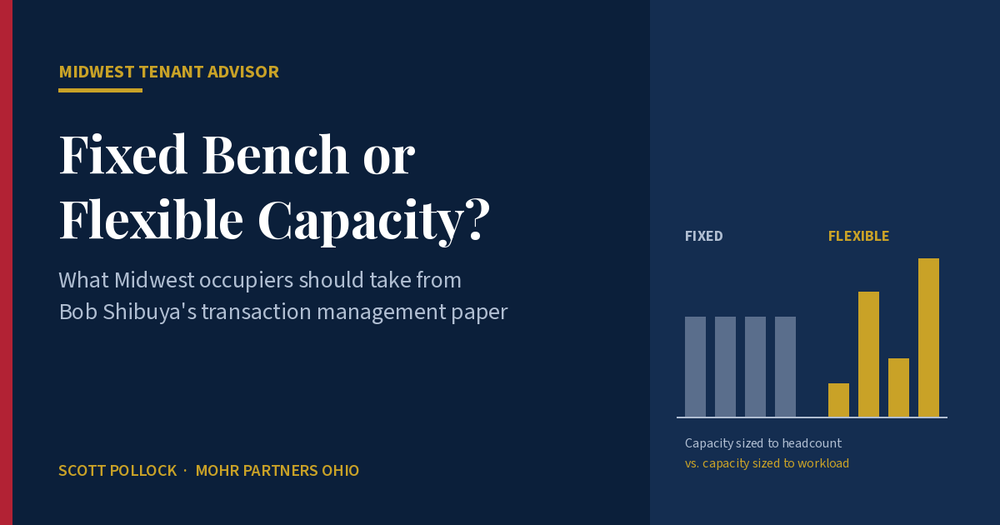
For roughly two decades, outsourced transaction management meant a fixed bench: a set number of transaction managers assigned to an account and paid through a flat management fee plus reimbursables, no matter how many renewals, dispositions, or acquisitions actually moved through the pipeline. That worked when portfolios changed slowly.
Bob's point is that this predictability is gone. Hybrid work recalibration, interest-rate-driven timing decisions, and M&A now produce sharp peaks and troughs. A portfolio that generated a steady 40 transactions a year might produce 15 one year and 70 the next. Under a fixed model, the client pays for an idle bench in slow years and gets an overstretched one in busy years. In busy years, stretched teams miss early renewal windows and drift into holdover.
The alternative is a shared pool of transaction managers who are allocated by pipeline and paid through per-transaction, tiered, hybrid, or retainer-with-true-up fees. The paper lays out a sensible transition path. Start by baselining 24 to 36 months of transaction history. Then pilot the model on a defined scope, such as renewals only. Finally, convert fully under quarterly governance, with a 12-month review right and a pre-agreed path back if the model underperforms.
"The client pays for transactions completed, not headcount held." — Bob Shibuya, Mohr Partners
Why This Matters Beyond the Fortune 500
Most companies reading this blog don't have a formal transaction management contract. A manufacturer with 12 facilities across Ohio and Indiana, or a professional services firm with offices in Columbus, Detroit, and Pittsburgh, typically handles its leases through the CFO, the COO, a facilities lead, and whoever has time that quarter.
That arrangement is also a fixed-headcount model, just an unpriced one. Internal capacity doesn't flex. When three expirations land in the same 18-month window alongside an acquisition, the same people who run the business are expected to run three negotiations, and the paper describes exactly what happens next. Renewal options get exercised by default, holdover clauses get triggered, and leverage is lost because no one had the time to build it.
The question Bob poses to large portfolio clients applies here too: are you paying for capacity, or for outcomes?
Your Landlord's Lender Is Now Setting Your Transaction Calendar
Bob identifies hybrid work, capital costs, and M&A as the forces making pipelines volatile. I'd add a fourth that matters a great deal in Midwest office markets: landlord debt.
More than $100 billion in CMBS loans comes due in 2026, much of it from 10-year loans originated in 2016 and 5-year loans from 2021. Per Trepp, office CMBS delinquency hit a record 12.34% in January and has hovered near 12% since. Much of that distress comes from maturity defaults rather than missed payments: sponsors can't refinance even when the building still cash-flows.
This matters for transaction management because a landlord facing a maturity it can't refinance becomes most motivated to trade concessions for a signed lease within a window measured in months. That window opens on the lender's calendar, not on your lease's expiration date. A team sized to your expiration schedule will be busy elsewhere when the opportunity appears.
Industrial occupiers face a version of the same timing problem. CBRE expects renewals to make up more than 35% of 2026 industrial leasing volume, well above the historical 24%, and occupiers are signing renewals earlier, about 219 days before expiration on average. Landlords are buying early commitments with tenant improvement allowances and free rent. Capturing that value depends on having capacity available when the offer is on the table.
Where I'd Push the Model Further
The paper is candid about the main risk of variable staffing: continuity of knowledge when the assigned team isn't static. I agree, and I'd be specific about which knowledge cannot be allowed to rotate.
Transaction managers can be interchangeable if the playbooks are good. Landlord intelligence cannot be. Every lease in your portfolio sits on top of a capital stack: an owner with a specific basis, a lender, and a maturity date. That information determines how much leverage you actually have. In a hybrid model, it belongs in the fixed governance layer as standing portfolio intelligence, not in the head of whichever transaction manager handled the last deal.
So I'd add a sixth question to Bob's list of five to ask any provider: can you show me which landlords in my portfolio face a loan maturity in the next 18 months, and what that means for my negotiating position? A provider who can't answer that is managing transactions, not leverage.
On Bob's conclusion I fully agree. Hybrid structures, with a modest fixed fee for governance and intelligence plus variable fees for execution, will become the default. For most mid-market occupiers, it's the right structure today.
Threats & Opportunities
Threats. Fixed internal capacity colliding with clustered expirations is the most common and least visible cost in mid-market portfolios, and it shows up as holdover premiums and default renewals at market rent. Variable arrangements carry their own risk: a provider's shared pool stretched across too many clients during a market-wide wave, which is exactly what the 2026 maturity cycle creates. Fee schedules with too many complexity multipliers can also become harder to audit than the fixed fee they replaced.
Opportunities. Run the baseline Bob recommends: pull 24 to 36 months of your transaction history and compare it against the next three years of expirations. Then overlay each landlord's debt position against those dates. Where a landlord's maturity falls before your expiration, you may have an early-renewal opportunity that your lease calendar alone would never reveal. If you're considering outsourcing, pilot it on renewals first, since that is where timing has the most value.
Read Bob's full paper here. To see where your own renewal windows fall, try the Lease Renewal Timing Engine or the Lease Leverage Read.
Scott Pollock
Managing Partner, Mohr Partners Ohio
scott.pollock@mohrpartners.com · 440.821.8149