How Much Land and Power Does an AI Data Center Need?
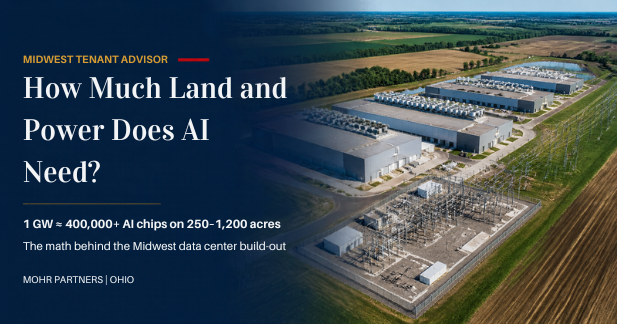
A one-gigawatt AI data center runs roughly 400,000 to 450,000 of today’s most advanced AI chips, and the gigawatt-scale campuses now being built in the Midwest sit on anywhere from about 250 to 1,200 acres. That makes the answer to “how much land and power does an AI data center need?” lopsided. Land is plentiful and comparatively cheap. Power is scarce and slow to deliver, and it now decides where a data center gets built and whether it gets built at all. For any company that needs data center capacity or a power-intensive facility in Ohio, Indiana, or Michigan, that imbalance should drive the entire site strategy.
How much compute does a gigawatt of power buy?
The cleanest benchmark is Nvidia’s GB200 NVL72, the rack-scale system behind most current AI buildouts. Each rack holds 72 GPUs and, per HPE’s published specifications, carries a nominal thermal design power of about 132 kilowatts. Assume a facility efficiency (PUE) of roughly 1.2, meaning about one-sixth of the power goes to cooling and other overhead. One gigawatt of facility power then leaves about 833 megawatts for computing. That supports roughly 6,300 racks, or about 450,000 GPUs.
The real world tracks the arithmetic. Oracle’s Larry Ellison said the Stargate campus in Abilene, Texas will use 1.2 gigawatts and eventually house more than 450,000 GB200 GPUs. That works out to about 375 chips per megawatt once every overhead is counted. The working rule: each megawatt of facility power runs roughly 375 to 450 frontier AI chips. New chip generations will shift the exact figure, but compute will keep scaling with power.
How much land does a gigawatt data center need?
Here the numbers spread widely. The Stargate campus Related Digital is developing in Saline Township, Michigan is planned for more than a gigawatt on 250 acres. Amazon’s Project Rainier campus in New Carlisle, Indiana, built to serve Anthropic, spans 1,200 acres and will ultimately draw 2.2 gigawatts. The Abilene Stargate campus sits on more than 1,000 acres for 1.2 gigawatts.
That works out to roughly 1 to 4 megawatts per acre. In compute terms, that is somewhere between 400 and 1,600 or more AI chips per acre. The variance is not driven by the servers, which need surprisingly little room. It reflects how much of each site goes to substations, generation, setbacks, buffers, and future phases.
Why is power, not land, the binding constraint?
Follow the money. Nvidia CEO Jensen Huang has said building AI data centers requires about $50 to $60 billion for each gigawatt of power consumption, and Barclays attributes 65% to 70% of that spend to compute and networking. Land barely registers. Even at a hypothetical $100,000 per acre, a 1,000-acre site costs about $100 million, less than 0.2% of a $55 billion project.
Power is the opposite. AEP Ohio reported in February 2026 that it has 17,861 megawatts of data center load under binding contract, scheduled to come online through 2035. Peak demand for all of AEP’s Ohio customers has run between 8,000 and 10,500 megawatts in recent years, so the contracted data center load alone is close to double the system peak. That is why developers now value these assets in dollars per megawatt rather than dollars per square foot. For these users, a parcel without a credible path to power is not really a site.
What does Ohio’s 10-gigawatt deal reveal about the capital stack?
The region’s largest project shows how power has become the asset. At the PORTS-Pike Technology Campus in Pike County, SB Energy will build, own, and operate the data center under a 20-year lease to OpenAI, which has agreed to secure about 8 gigawatts of IT capacity. SB Energy says it will pay the full cost of the grid upgrades and new transmission lines, and it plans at least 10 gigawatts of new energy infrastructure, including a $33 billion power plant and $4.2 billion in transmission. Nvidia is providing credit support for the land, power, and shell buildout behind the first 4.25 gigawatts. It has reportedly agreed to cover up to $105 billion of value if the site has to be sold. The first 800 megawatts are scheduled for 2028, and the buildout runs through 2032.
Read that structure the way you would read any landlord’s capital stack. The developer’s value is not in the land; it is in the power. The tenant’s long lease is what makes the power financeable, and a third party, here the chip supplier, is guaranteeing the downside. Smaller users feel the same logic. Midsize colocation and retail operators are competing for 20 to 50 megawatts of capacity while hyperscalers chase gigawatts. Whoever controls energized capacity holds the leverage. The terms you negotiate on power delivery dates, expansion rights, and cost pass-throughs matter more than the rent per square foot.
Which Midwest data center incentives are still available?
Incentives are shifting fast, and Ohio is the outlier. On May 27, 2026, Governor DeWine directed the Ohio Tax Credit Authority to pause consideration of new data center tax exemption requests while the General Assembly’s Joint Data Center Committee studies the industry. Existing approvals remain in effect, but new projects cannot currently obtain the sales and use tax exemption. That exemption cost the state about $1.6 billion in 2025, and lawmakers have debated repealing it or cutting it to 50%. As of this writing, the pause remains in place. Local resistance is rising too. Twenty-one data center measures are on Ohio’s November 3 ballots, and at least 138 Ohio municipalities and townships have adopted moratoriums.
Neighboring states remain open for business. Indiana exempts qualifying data center equipment and energy from sales and use tax for up to 25 years, or up to 50 years for investments above $750 million. Michigan’s data center exemption runs through 2050 for projects that invest at least $250 million and create at least 30 jobs paying 150% of the regional median wage, with clean energy and green building requirements attached. Repeal bills have been introduced in Lansing but not enacted. For a user weighing a multi-state search, the incentive gap between Ohio and its neighbors is now a real number in the pro forma.
Threats & Opportunities
The threat. The biggest threat is treating a data center or power-intensive project as a real estate search. The parcel is the easy part. The hard parts are the utility’s committed delivery date, the collateral and minimum-demand obligations that come with it, the local zoning trajectory, and an incentive landscape that changed in Ohio this year. Companies that lock in a site before confirming those variables risk carrying land and lease obligations against power that arrives years late.
The opportunity. Because power is the constraint, it is also the leverage. Users can secure capacity, incentives, and economics that latecomers will not see if they:
- quantify their real megawatt needs,
- run parallel searches across Ohio, Indiana, and Michigan, and
- negotiate power delivery and expansion rights into the lease instead of accepting a developer’s standard terms.
Mohr Partners represents only the occupier, never the landlord or developer. Our team includes dedicated business incentives and energy advisory specialists who work alongside the site search.
Frequently asked questions
How many AI chips can one gigawatt of power support?
Roughly 400,000 to 450,000 of Nvidia’s current Blackwell-generation GPUs, based on published rack specifications and the Stargate Abilene deployment of more than 450,000 GB200 GPUs on 1.2 gigawatts.
How many acres does a gigawatt-scale data center need?
Current Midwest projects range from 250 acres for more than one gigawatt in Saline Township, Michigan, to 1,200 acres for 2.2 gigawatts in New Carlisle, Indiana. That is roughly 1 to 4 megawatts per acre.
Can new data centers still get Ohio’s sales tax exemption?
Not currently. Ohio paused consideration of new data center tax exemption requests in late May 2026 while a legislative committee studies the industry. Previously approved exemptions remain in effect.
For a confidential discussion about securing data center capacity, power, or incentives for your next facility, contact Scott Pollock, Managing Partner at Mohr Partners Ohio: scott.pollock@mohrpartners.com · 440.821.8149