Indianapolis Industrial Rents Jumped 10%. Your Leverage Moved to Buildings Still Under Construction.
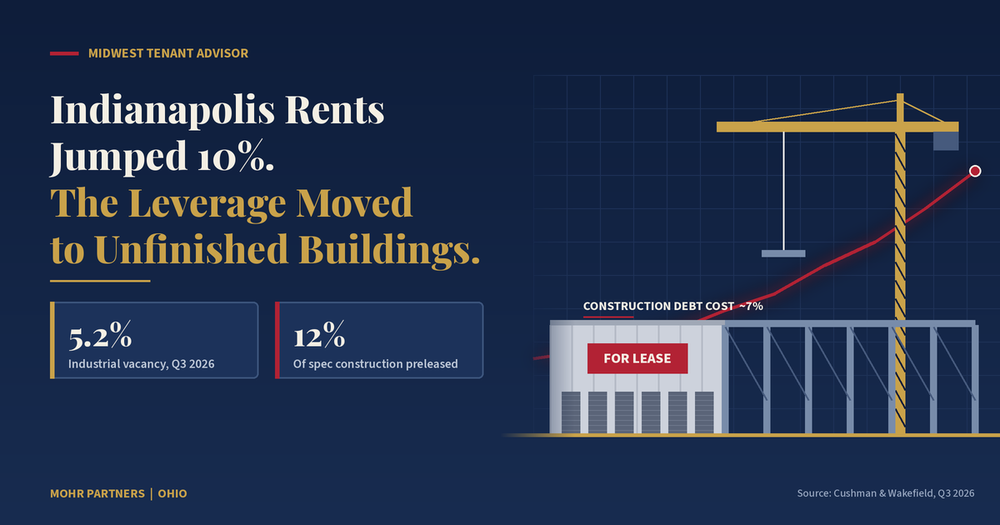
Can a tenant still negotiate a good industrial lease in Indianapolis? Yes, but not where most occupiers are looking. Existing space is nearly gone. Overall industrial vacancy fell to 5.2% in Q3 2026, its lowest level since 2022, and average asking rents rose 10.2% year over year to $6.60 per square foot, according to Cushman & Wakefield. The tenant leverage that remains in the Indianapolis industrial market sits in roughly 4.2 million square feet of speculative warehouse space that is under construction and not yet leased. Those developers are carrying floating-rate construction debt in a rising-rate market, and every vacant month costs them money they never get back.
That is a reversal from June, when we argued that Indianapolis industrial leverage was hiding in vacant modern bulk buildings. Most of that space has since been leased. The leverage didn't disappear. It moved down the development pipeline.
What happened to Indianapolis industrial vacancy in 2026?
Demand ran hot all year. The market absorbed 3.8 million square feet in Q3, its fifth straight quarter above 3.0 million, pushing year-to-date absorption to 11.9 million square feet, up 48% from 2025. Over the past twelve months, tenants absorbed 13.5 million square feet of vacant space. Big users drove it: thirteen deals over 100,000 square feet accounted for 83.5% of new leasing, led by Keller Logistics Group's 806,000-square-foot commitment in the East submarket.
Two details matter more to occupiers than the headline. First, the cheapest option in the market has been cut in half. Available sublease space fell from 2.7 million square feet a year ago to 1.4 million. Second, the West, Northeast and Northwest submarkets now sit between 3.1% and 3.5% vacancy, which in practice means a mid-size user needing space in the next six months is choosing from a handful of buildings.
One caution on that 10.2% rent figure. Cushman & Wakefield notes that part of the increase reflects a change in what is left to lease: lower-priced modern bulk space was absorbed, leaving a more expensive pool behind. Like-for-like rents rose, but not by 10%. Expect landlords to quote the headline number at renewal. It overstates the move, and your advisor should say so at the table.
Why do spec warehouse developers need to sign tenants now?
Because they started building into a credit market that turned against them. The Indianapolis construction pipeline climbed to 8.9 million square feet, triple the level of a year ago. Speculative construction alone reached 4.8 million square feet, up from 0.5 million a year earlier, and only 12.2% of it is preleased.
Most of those projects are financed with floating-rate construction loans. The Federal Reserve raised its target rate to 3.75%–4.00% in September, its first hike since 2023, and the 10-year Treasury climbed above 5%. Banks typically price construction debt at Term SOFR plus 2.75 to 3.75 percentage points, according to Terrapin Capital Group, which puts all-in borrowing costs in the high-6% to mid-7% range for strong sponsors.
Here is what that means in a single building. The figures below are illustrative assumptions, not a specific project. Take a 1-million-square-foot spec bulk facility at about $90 per square foot all-in, financed with a 60% construction loan of $54 million at 7%. Interest alone runs about $3.8 million a year, or roughly $315,000 a month. That is $3.78 per square foot per year, more than half the market's average asking rent, before taxes, insurance, or a dollar of return to equity.
That loan is interest-only and funded partly from a finite interest reserve. The developer gets out of it by leasing the building, which supports a permanent loan or a sale. If the reserve runs dry before lease-up, the sponsor writes a check or renegotiates with the lender. This is the capital-stack pressure we described in Your landlord's mortgage is your best leverage in 2026, applied to buildings that don't have a tenant yet.
The clearest signal came in Q3. Three spec buildings delivered fully vacant, and two of them, 65 Commerce Park Building 7 (286,000 SF) and Park 65 Building 1 (202,000 SF), are in the Northwest, one of the market's tightest submarkets. A tight submarket with empty new buildings tells you the landlord's problem isn't demand. It's timing.
What should Indianapolis industrial tenants negotiate for?
Trade face rent for effective rent. Lenders and buyers value a building on its rent roll, so spec developers care most about the headline rate. Many will hold face rent near asking but give generous free rent, a larger improvement allowance, or lower annual escalations. Accept a defensible face rate and take the economics in the concessions.
Get your specs built while design is still open. Clear height, dock count, trailer parking, office buildout and electrical capacity cost far less to change on paper than after delivery. A pre-lease tenant can often get these at the landlord's expense.
Protect the delivery date. Pre-leasing a building under construction shifts schedule risk to you. Negotiate rent