Pittsburgh Office Market: One Vacancy Rate, Two Very Different Negotiations
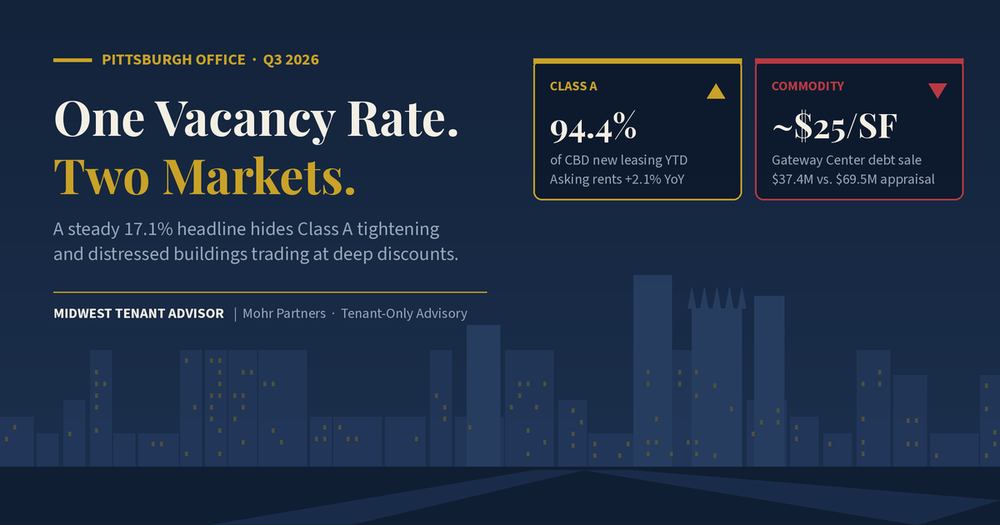
The Pittsburgh office market closed the third quarter of 2026 at 17.1% vacancy, according to Cushman & Wakefield. That is only 20 basis points below the all-time high set in Q1 2025, and the headline rate has stayed within a 40-basis-point band for two full years. A number that steady looks like a market in equilibrium. It isn't. Two markets are moving in opposite directions, and their average describes almost nobody's lease.
For a CFO or COO with a Pittsburgh lease expiring in the next three years, the useful question is not "what is vacancy?" It is "which of the two markets is my building in, and what does my landlord's balance sheet look like?"
The Pittsburgh Office Market Is Splitting by Quality
Start with the top of the market. Class A space has absorbed nearly 290,000 square feet on a net basis since the start of 2025, including 68,000 square feet in Q3 alone. Class A took 71.8% of all new leasing across the metro, and 94.4% of new leasing in the CBD. Renewals show the same pattern: more than 91% of renewed CBD space was Class A. Occupiers are staying in quality buildings rather than re-entering a market with few top-tier options and high buildout costs. Class A asking rents are up 2.1% year-over-year, and no significant office construction has been underway for eight consecutive months.
Now look below the top tier. CBRE data compiled by the Pittsburgh Downtown Partnership put CBD direct vacancy at 19.0% and direct availability at 22.3%. Availability measures space that is coming, while vacancy measures space that is already empty, so the gap between them is future vacancy. The Partnership estimates that 8.2 million square feet, roughly 35% of Downtown's office inventory, should ultimately convert to non-office use.
One market is running short of good space. The other has more space than it will ever lease.
What the Capital Stack Shows That Vacancy Doesn't
The clearest signal is in the debt, not the leasing reports. This summer, the $92 million CMBS loan on Gateway Center, the roughly 1.5-million-square-foot complex at the Point, was liquidated through a note sale. Gross proceeds were $37.4 million against a prior appraisal of $69.5 million, and bondholders absorbed a $64.8 million loss. That works out to about $25 per square foot for one of Downtown's most visible office addresses.
Gateway Center is not an isolated case. The Heinz 57 Center was reappraised at $19.8 million in May. The CMBS loan on the U.S. Steel Tower moved to special servicing this spring. In August, a three-building, 351,000-square-foot portfolio at Parkway Center was sent to online auction. Nationally, the CMBS special servicing rate reached its highest level since early 2013.
As we've argued before, your landlord's mortgage is often your best leverage. In Pittsburgh right now, that leverage depends on which of three landlord types sits across the table:
- The legacy-basis Class A owner with healthy debt. This owner has pricing power and knows it. Concessions are compressing, and the absence of new supply means it doesn't have to chase you.
- The legacy-basis owner with a loan in special servicing or near maturity. On paper you have leverage. In practice, every lease needs servicer approval, and the landlord may not be able to fund the tenant improvements it promises.
- The fresh-basis owner. This is a note buyer, auction buyer, or recapitalized owner whose cost basis is a fraction of replacement cost. It can underwrite rents well below the market, but its willingness to reinvest in the building is the open question.
For Class A Tenants, the Risk Is Timing
If you occupy Class A space Downtown with an expiration in 2027 or 2028, the trend is moving against you. Your landlord can see the same renewal data you can: nine of ten CBD renewals stay in Class A because there are so few alternatives. With no new supply arriving, every quarter you wait shrinks your options.
The answer is to start earlier, 24 to 30 months before expiration, and to build a credible alternative before you open renewal talks. In this market, the most credible alternative is often a well-located B+ building that a fresh-basis owner is repositioning. That owner can offer a rent your current landlord has to take seriously. We made a similar point about the office price recovery: leverage hasn't disappeared, it has moved.
For Value Seekers, the Cheap Building Isn't Automatically the Good Deal
A $25-per-square-foot basis means a landlord can offer a very low rent. It does not mean the landlord will perform. Before signing in a distressed or newly traded building, tenants should confirm four things:
- Who holds the debt, and is there an SNDA? A note buyer that forecloses can disrupt an unprotected lease.
- Are tenant improvement dollars secured? Require an escrow or letter of credit, not a promise.
- What is the building's capital plan? Deferred HVAC, elevator, and façade work becomes your daily operating problem.
- Is the building a conversion candidate? With 35% of Downtown's inventory flagged for non-office use, redevelopment termination and relocation clauses need careful negotiation.
Threats & Opportunities
Threats
- Class A availability keeps shrinking with no new construction, which erodes renewal leverage for top-tier tenants who wait.
- Landlords in special servicing may be unable to approve deals quickly or fund promised improvements.
- Conversion activity can surface as early termination rights in leases that don't anticipate it.
Opportunities
- Fresh-basis owners can price space well below legacy owners, which gives Class A tenants a real negotiating alternative.
- Early blend-and-extend renewals can lock in terms while Class A rent growth is still a modest 2.1%.
- Tenants with flexible space needs can find value in the sublease market, provided they underwrite the sublandlord's credit as carefully as the space.
Know Which Market You're In
Pittsburgh's 17.1% vacancy rate won't tell you what your next lease should cost. Your building's quality tier, your landlord's debt position, and your timeline will. Mohr Partners represents tenants exclusively and never landlords. We help occupiers across Western Pennsylvania, Ohio, and the broader Midwest read the capital stack behind every option before they negotiate.
To discuss your Pittsburgh lease strategy, contact Scott Pollock, Managing Partner, at scott.pollock@mohrpartners.com or 440.821.8149.
Sources: Cushman & Wakefield Pittsburgh Office MarketBeat Q3 2026; Pittsburgh Downtown Partnership, State of Downtown Pittsburgh (CBRE data); Commercial Observer / Morningstar Credit; Commercial Real Estate Direct; Bisnow / Trepp.