The Detroit Office Market Is "Turning."
The Detroit office market has a new talking point this fall: the bottom is in. Class A vacancy ticked down in the second quarter, Southfield led suburban absorption earlier this year, and landlord-side brokers are telling occupiers the window to lock in today's pricing is narrowing. Some of that is true. None of it answers the question that actually governs your next renewal: can your building's owner refinance its debt at today's rates? Last Wednesday, the Federal Reserve made that question much harder to answer yes.
What the Detroit Office Market Data Actually Says
Start with the numbers the "turning" narrative rests on. CBRE put metro Detroit office vacancy at 19.4% in Q2 2026, with Class A down 70 basis points to 18.8%. That is real improvement at the top of the market. But the same report shows average asking rents declined to $20.68 per square foot. Newmark's Q1 read was sharper: 757,000 square feet leased across 173 deals, against 25-year quarterly averages of 1.67 million square feet and 327 transactions. Suburban vacancy sat at 22.2%.
Read together, that is stabilization, not tightening. A market leasing at less than half its long-run pace, with rents slipping, is not a market where tenants are about to lose leverage. It is a market where the best-capitalized buildings win the few deals that close, and everyone else competes harder for the next one. Which is exactly why the vacancy rate is the wrong lens. The capital stack is the right one.
The Fed Just Repriced Every Maturing Suburban Office Loan
On September 16 the Fed raised its benchmark rate a quarter point to 3.75–4.00%, its first hike since 2023, and the 10-year Treasury is sitting near 20-year highs. For office landlords, the policy rate matters less than what it signals: the refinancing relief the industry spent two years waiting for is not coming in 2026, and may not come in 2027.
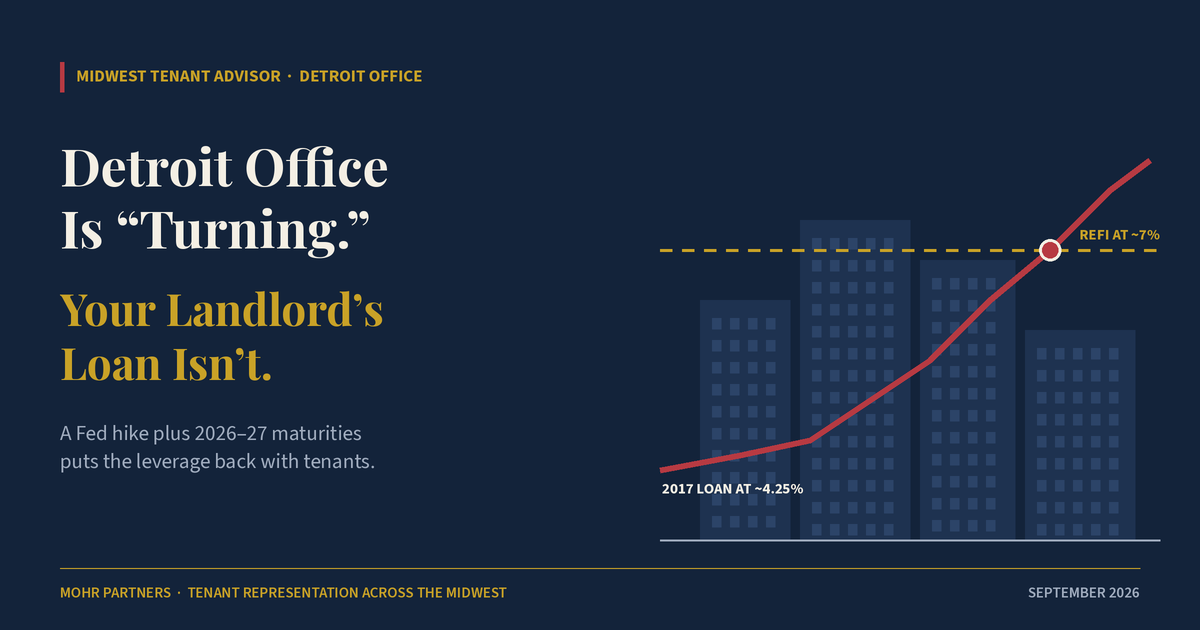
Consider a typical Troy or Southfield asset financed with ten-year CMBS debt in 2016 or 2017, when fixed rates ran in the low 4% range. That loan matures in 2026 or 2027. As an illustration, a $30 million balance at 4.25% carries roughly $1.3 million in annual interest. Refinanced at roughly 7% today, the same balance costs about $2.1 million. That is an $800,000-a-year hole, before accounting for the harder problem: the new lender sizes the loan off today's value, not 2017's. Most of these owners are not facing a higher payment. They are facing a check they have to write to get the refinance done at all.
The national data shows how that ends when the check can't be written. Trepp's CMBS special servicing rate hit 11.42% in August, the highest since February 2013. In July, two-thirds of newly delinquent balances were loans that simply failed to pay off at maturity. This distress is not being driven by tenants leaving. It is being driven by debt coming due. We made the broader version of this case in why your landlord's mortgage is your best leverage in 2026. Detroit is where it is about to get tested.
Two Buildings, Same Vacancy, Opposite Leverage
Picture two suburban Detroit office buildings, both 78% occupied, both quoting similar rents. On a flyer they are interchangeable. Building A traded in 2022 at a reset basis with moderate leverage. Building B carries 2017 CMBS debt maturing next year.
Building A's owner can afford to wait for the right tenant. Building B's owner cannot. A signed long-term lease from a credit tenant is the single most valuable document in its refinance package, because it is the collateral the new lender will underwrite. For that owner, the window is not closing. It is opening, and your signature is what it needs to get through it. As we noted when office prices started recovering, leverage does not disappear in a turning market. It moves to specific buildings.
Before any Detroit-area renewal, you should know four things about your landlord: the loan maturity date, the lender type (CMBS, bank, or life company), whether the loan is on a servicer watchlist or already in special servicing, and what the owner paid versus what the building is worth today. CMBS loan performance is publicly reported. Most tenants simply never look.
Threats & Opportunities
Threats
- Unfunded improvement dollars. An owner headed toward maturity default may be under a lender cash sweep. A generous TI allowance means nothing if the landlord cannot fund it. Tie allowances to escrow or rent offsets.
- No non-disturbance protection. If the loan goes to a receiver or lender, your lease terms survive only if you have a signed SNDA. Get it before you sign, not after.
- Urgency by narrative. "The window is closing" is a sales argument. The same logic that applied to closing sublease windows applies here: speed benefits the side that needs the deal done.
Opportunities
- Maturity-driven concessions. Owners with 2026–2027 maturities will trade rent, free rent, and TI for term and credit, now.
- Early renewals on your terms. A lease expiring in 2028 at a building with a 2027 maturity is worth renegotiating today, while you are an asset to the refinance rather than a risk to it.
- Flexibility as currency. Expansion rights, contraction options, and early terminations cost a cornered owner little and protect you if the building changes hands.
Mohr Partners represents tenants only. Our Michigan practice is led by Mike Sabatini. If your Detroit-area lease expires in the next 24 months, we will pull the debt behind your building and tell you how much leverage its loan is handing you. Contact Scott Pollock at scott.pollock@mohrpartners.com or 440.821.8149.