Your CAM Bill Went Up in 2026. Half of It Should Have Gone Down.
Most tenants read a CAM reconciliation the way they read a utility bill: total at the bottom, a shrug, a check written. But in 2026, two of the largest line items buried in your operating-expense pass-throughs moved in opposite directions — and the gap between them is quietly landing in your column. Commercial property insurance just posted its first broad price decline in nearly a decade. In the same window, the wholesale cost of electricity across the eastern grid hit a regulated ceiling for the third year running. One of those should be lowering your occupancy cost. The other is raising it. Whether you see either one depends entirely on how closely someone reads the reconciliation — and whether your lease gives you the standing to.
The insurance line finally broke — downward
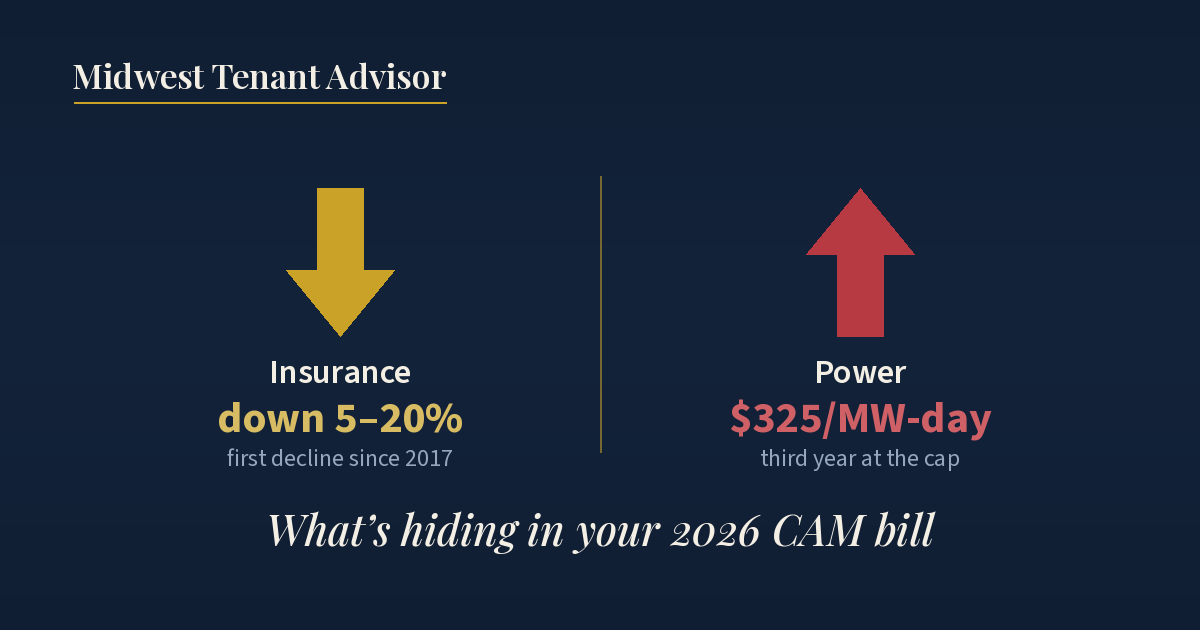
After roughly eight years of relentless increases, the commercial insurance market turned. Industry surveys logged the first broad premium decline since 2017, ending a streak of more than 30 consecutive quarters of rate hikes. Property led the reversal: mid-year 2026 reports put commercial property rate decreases at 5% to 20%, with non-catastrophe accounts seeing the steepest relief and average property rates down around 10%. Analysts expect property to keep drifting down through the rest of the year.
Translate that into lease terms. The insurance "N" in your triple-net — the premium your landlord pays and bills back to you — should be flat to down at your next reconciliation. If it holds steady or climbs, someone is keeping the difference. And a landlord under financial pressure has every reason to. As we've written before, your landlord's mortgage is often your best leverage: when the debt is expensive and a refinance is looming, the owner's priority shifts from recovering costs to protecting net operating income — and a quietly falling cost is the easiest place to hold margin.
The power line is doing the opposite
Now the cost moving the other way. On July 14, PJM — the grid operator for all of Ohio and Western Pennsylvania and parts of Indiana, Michigan, and Kentucky — cleared its 2028/2029 capacity auction at $325 per megawatt-day, the FERC-approved ceiling, for the third consecutive year. It came up roughly 6,800 megawatts short of its own reliability target. The cause is no longer debated: data-center demand is outrunning new generation, and those capacity charges flow into commercial power bills across the entire footprint. Without the price cap, PJM's own simulation had the auction clearing 71% higher.
For a tenant, power surfaces in two places — the meter you pay directly, and the pass-through buried in CAM for shared HVAC, common areas, and building systems. Industrial occupiers feel it first and hardest, but no office tenant sharing a central plant is insulated. And this line isn't reverting: the cap that's holding it "down" has been extended through the 2029/2030 delivery year.
The asymmetry is the whole story
Here is what almost no broker is connecting for tenants: one pass-through is falling and one is rising, in the same year, on the same reconciliation. A landlord who does nothing — just bills the actual numbers — passes the power increase through and passes the insurance decrease through, and it nets out roughly honest.
But a landlord under capital-stack pressure doesn't do nothing. This is the same dynamic we traced at the loan level when we argued that leverage doesn't disappear — it moves. Falling insurance is the easiest cost to soften and slow-walk: estimate high, reconcile late, blend it into a category you can't see line-by-line. Rising power, meanwhile, gets passed through cleanly and on time. The tenant watches one number climb and assumes the market did it. Half the market went the other way.
What actually gives a tenant leverage here
This isn't about trusting — or distrusting — your landlord. It's about what your lease lets you verify. Four provisions do the work:
- Audit rights with teeth. The right to inspect the books behind the reconciliation, paired with a real refund mechanism — not a 30-day objection window that expires before you can act on it.
- Insurance pass-back language. Wording that ties the insurance component to actual premium, so rate decreases flow through to you — not just increases.
- Controllable-expense caps — and their trap. Caps limit CAM growth, but property taxes and insurance are usually carved out as "non-controllable," meaning a reassessment or premium can pass through in full even under a cap. Know exactly what your cap covers.
- Utility and gross-up review. For heavy-power users, a defined method for allocating capacity and demand charges — and a check on whether a gross-up clause is quietly billing you for a vacant neighbor's share.
None of this is exotic. It's standard — for tenants who ask. Most don't, because a reconciliation statement looks like a fact rather than a negotiation.
Threats & Opportunities
Threats. Power costs across the PJM footprint are structurally rising and won't ease on the next auction — the ceiling is locked in through 2029/2030. Tenants sitting on uncapped, loosely defined CAM will absorb that with no upper bound. And a soft insurance market gives a stressed landlord room to hold onto a credit you'll never see unless you look for it.
Opportunities. The insurance turn is a genuine, checkable dollar in your favor — the first in nine years. Reconciliations and renewals happening right now are the moment to install audit rights and pass-back language before the next power auction lands. And if you're touring or renewing, remember that total occupancy cost — not the headline base rent — is the number that matters. Pass-through terms are more negotiable than ever in a market where landlords need signed tenants to service their debt.
The advisor's job here is diagnostic: read the split most tenants can't see, and price the leverage hiding inside it. If your next reconciliation or renewal is on the horizon, reach Scott Pollock to pressure-test the operating-expense terms behind your lease — scott.pollock@mohrpartners.com · 440.821.8149.