Your Landlord Bet on a 2026 Rate Cut. This Week, the Fed Is Raising Instead.
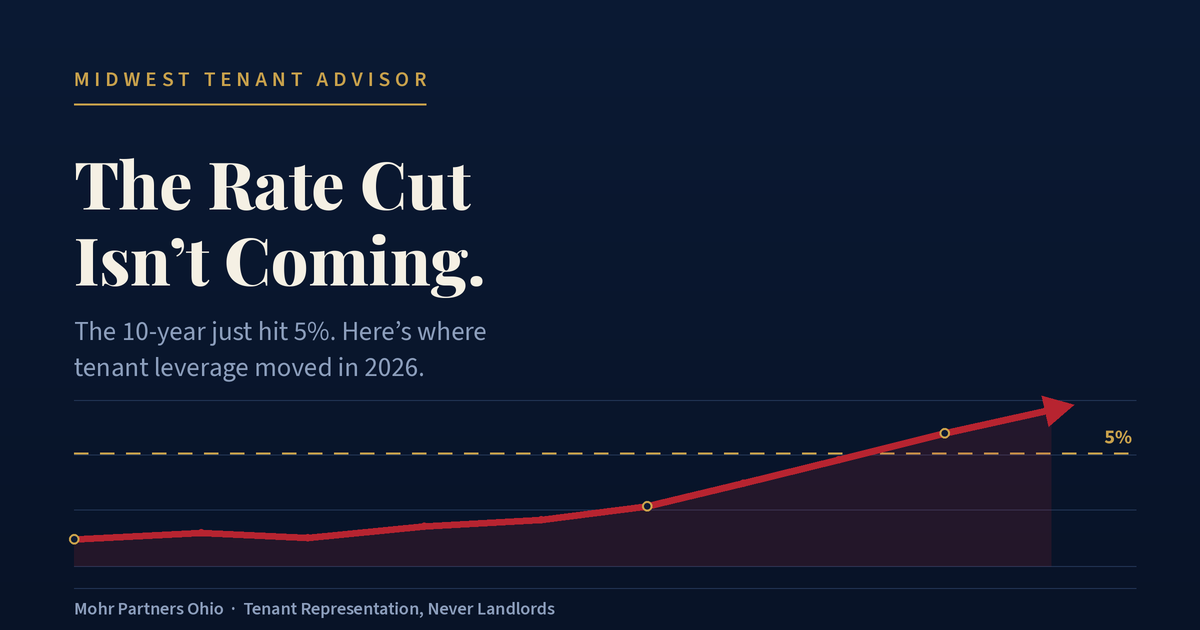
The number that decides your next lease negotiation isn't the one the Federal Reserve will announce this week. It's the one already flashing on every bond desk in the country: the 10-year Treasury touched 5% on Monday, its highest level since October 2023. That is the rate that quietly prices your landlord's next mortgage — and for a Midwest tenant, the tenant leverage it creates is pointed in exactly the direction the headlines will tell you to ignore.
For two years, the entire commercial real estate playbook rested on one assumption: rates would fall in 2026. This week, the Fed is expected to do the opposite.
The bet that just collapsed
Through 2024 and 2025, distressed landlords didn't repair their balance sheets. They bought time. The industry even had a name for it — "extend and pretend": modify the loan, push the maturity out a year or two, and refinance later once rates came down. It was a wager, and the whole wager was on the Fed.
That wager is now unwinding in real time. With a steady labor market and stubborn energy-driven inflation, the Fed is widely expected to raise the federal funds rate this week — the first increase since 2023. Every owner who extended a loan in 2024 expecting a friendlier 2026 is now staring at a market that moved against them.
The rate that actually prices your landlord's loan
Here is the distinction most tenants miss, and it is the whole game. The Fed funds rate governs short-term credit. Your landlord's building loan is priced off the 10-year Treasury plus a spread. With the 10-year near 5%, a typical commercial refinance today clears in the high 6s to low 7s. Most of the debt hitting the wall was written at 3% to 4% in the low-rate years.
The Mortgage Bankers Association estimates roughly $875 billion in commercial mortgages — about 17% of everything outstanding — mature in 2026, with borrowers refinancing into rates 150 to 250 basis points above their original loans. That is not a rounding error. On a $30 million building, a 200-basis-point reset is roughly $600,000 a year in new debt service — money that has to come from somewhere, and that somewhere is the rent roll.
Why this lands in your renewal
A landlord facing a maturity default has one asset a lender genuinely cares about: signed, long-dated leases. Refinancing math runs on debt-service coverage, and debt-service coverage runs on in-place income the lender can underwrite. This is why your landlord's mortgage is your leverage in a way the asking rate never reveals — a cash-flowing building can still fail to refinance, because the current distress is driven by maturity defaults, not missed monthly payments. Owners who can't clear the new rate hurdle lose the asset even while it is fully leased.
That is precisely why your renewal signature is worth more than the rent number suggests. To a landlord nine months from a maturity, your executed lease is the line between a financeable building and a foreclosure. The tenant who understands that doesn't negotiate against a rate — they negotiate against a refinance deadline. Free rent, tenant-improvement allowances, and blend-and-extend structures are all reachable for an owner who has to show a lender stabilized income before the loan comes due.
Not every landlord is squeezed — and that's the point
This is where surface market data fails you. A blended vacancy rate cannot tell you which landlord is desperate and which is comfortable, because the pressure lives in the capital stack, not the leasing sheet. Office is the epicenter: CMBS office delinquency hit an all-time high above 12% in early 2026, and for office loans that already matured without resolving, delinquency runs north of 80%. Industrial is the near-opposite — lean maturity exposure, occupancy near 97%, and lenders still competing to refinance quality product.
Two identical-looking buildings across the street from one another can sit on opposite sides of that line. The one whose owner bought at peak basis in 2021 on a five-year loan is your opportunity. The one held free-and-clear by a pension fund is not. You cannot tell them apart from the marketing flyer. You can only tell them apart by reading the debt — which is the same discipline behind why a recovering price index didn't erase your leverage; it just moved it to the loan level.
Threats and opportunities
The opportunity: If your lease expires in the next 18 to 24 months and your building carries maturing, peak-basis debt, this is one of the strongest negotiating positions a tenant has held this cycle. The landlord needs your term to survive their refinance, and this week's rate move only sharpened that need.
The threat: Leverage is neither evenly distributed nor permanent. Push a genuinely distressed landlord into default and you can inherit a receiver, a capital-starved building, and deferred maintenance you now live inside. On the industrial side, where distress is low and demand is firming, the tenant edge is already thinner. The move is to diagnose the specific building's debt position before you set strategy — not to assume every landlord is either desperate or safe. Our Lease Leverage Read is built to size exactly that gap.
The rate environment turned this week. Most occupiers will read the Fed headline and conclude the CRE distress story is finally easing. The opposite is true — and the leverage it creates is real, but only for tenants who know to look at the loan, not the listing.
Scott Pollock is Managing Partner at Mohr Partners Ohio, where he represents corporate tenants — never landlords — across Ohio, Michigan, Indiana, Kentucky, and Western Pennsylvania. If your lease expires in the next 24 months, he can read your building's capital stack and tell you how much leverage the refinance math is handing you. Reach him at scott.pollock@mohrpartners.com or 440.821.8149.